

If Marcus Bibbero was once as well known as William Wilberforce as suggested in his obituary, he was not similarly memorialised with a statue in his home town of Hull.
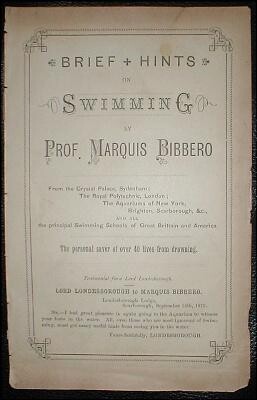
The reason for his omission could not be because he was invisible to the city. His life was well-publicised, appearing in regional and national press as well as publishing books like the one below.
He was a sporting darling in Great Britain, an ambassador for swimming and when he travelled round the country people called him ‘Professor Bibbero.’
Substantial information about Marcus can be found in various fragments of ephemera and artefacts that remain. Some of them are on this website and a short summary of his life can be found in the biography of his great-niece, Mira B. Johnson.
Reflecting on his life calls into question what we can piece together from what remains.
In his lifetime Marcus was known as a phenomenal athlete with a flair for performance, he was not shy of publicity and talked about his life in enough arenas to distinguish fiction from fact.
Records of the Jewish population in Hull from 1766 to 1880 emphasise his presence in a large municipal city, although sometimes contraversial in the reasons why.
It is certain that he knew Matthew Webb the famous channel swimmer and and yet his input into Webb’s training and death is not mentioned in what survives about the unlucky swimmer, who lost his life in his presence.
Wikipedia mentions that he ‘took on another manager’ after Fred Beckwith resident Professor at London’s Lambeth Baths, but does not name Bibbero or another person; it is as if the team surrounding Webb was not as important as the man.
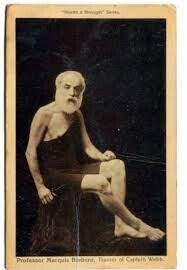
Marcus was 8 years older than his counterpart and was known as ‘Professor Bibbero,’ an accolade with enough publicity in the national newspapers as well as word of mouth to make him the first thought about who would be an ideal trainer and guide.
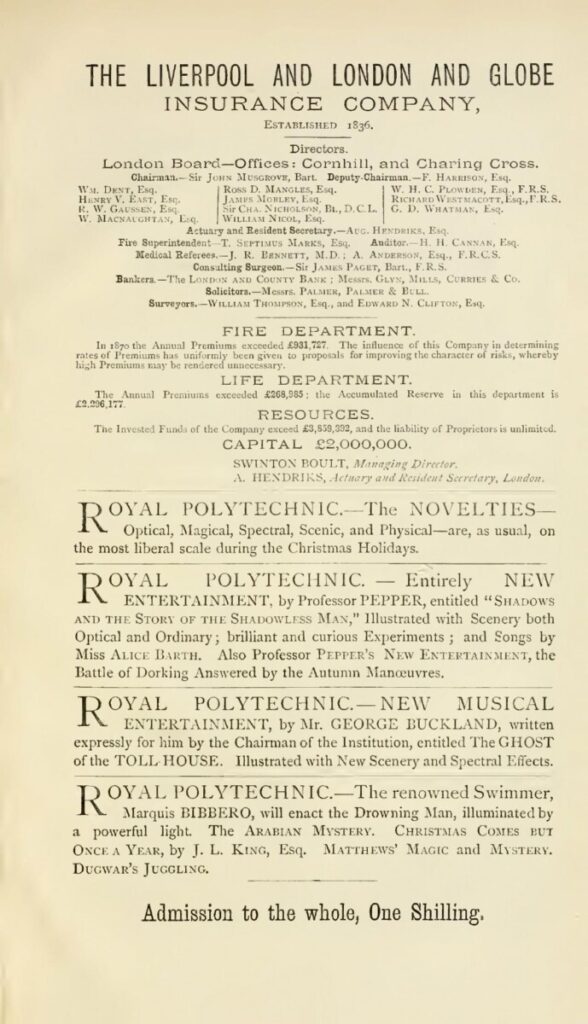
Webb and Bibbero were similar, perhaps playing off their personalities, egging each other on. Both had athletic prowess coupled with an adventurous spirit and the ambition to do things that had never been achieved by other men.
Like Webb, Marcus attracted attention and was comfortable in the presence of royalty as well as the humble orphans he taught swimming to in his home town.
Of the present-day links here are some suggestions for further reading
Marcus’s history and some newspaper articles are on channelswimmingdover.org.uk
https://www.channelswimmingdover.org.uk/content/photo/death-of-bibbero-dover-express-25-3-1910
https://www.channelswimmingdover.org.uk/content/swimmer/bibbero-marcus
https://www.dawleyheritage.co.uk/unpublished-articles/350/biography-of-capt-matthew-webb-by-m-peel
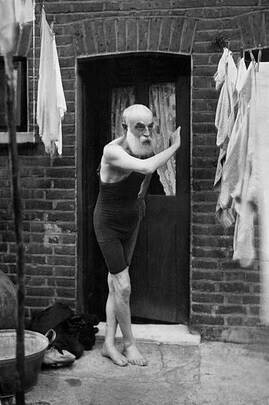
Photos of Marcus held at the National Archives, Kew.
https://discovery.nationalarchives.gov.uk/details/r/C10343560
https://discovery.nationalarchives.gov.uk/details/r/C10343561
https://discovery.nationalarchives.gov.uk/details/r/C10343562
With the passage of time fading information becomes like morse code, its dots and dashes suggestive of a wider life.
His obituary speaks to one of flair, talent, determination and success. Marcus Bibbero was a pioneer, a one-off talent rather like his great-niece Miriam Bibbero Johnson.