Readers, click the cross top left to remove the preview and use two fingers to enlarge on screen
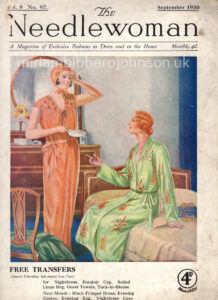
In September 1930 hemlines had already started dropping to the long, slim lines seen throughout the rest of the decade and it was picked up in Needlewoman magazine.
On page 5 Debenham and Freebody the department store in central London, displays a gown designed and made to the new lines embroidered all over with what they call a ‘spot motif.’
In the Thirties Debenham and Freebody had Workrooms where models – one off items of clothing – were designed and made for customers.
Housing seamstresses with a variety of skills, Workrooms were the places where items were designed and created and unlike mass-manufacturing employees would take all aspects of its creation like an Haute Couture Atelier in the present-day.
Once the design was agreed on, the embroidery would be planned. Motifs were a repeated decoration like a flower or in this case two curved lines, a abstract interpretation of the polka dot so fashionable in the decade.
Some fabrics could be manufactured with motifs woven into the design but others would take experienced seamstresses to do it instead.
Embroidering them across an entire gown would have taken considerable time and preparation which included stretching the fabric across frames to make it taught before marking it with the repeated pattern in even intervals across its shape.
Once that was complete, the embroidery would begin. Seamstresses would work in even, measured stitches over the entire gown from front to back, making sure their stitches were uniformly finished. They’d have been trained in the skill and learned more on the job as apprentices.
Couturiers who had the personnel to carry out this type of sewing charged a fortune for completing hand-sewn items. Instead readers of the Needlewoman magazine were lead through the same steps on pages 8, 12 and 13, 15 and 16.
Flick through its pages and see the times a-changing. Page 25 shows the old line – a knee length tennis dress – but the the Debenham and Freebody dress indicates the way forward.
By 1930 skirt lengths will have dropped to mid-calf and wouldn’t rise again until the end of the decade.
Want to know more about Mira’s other career? Watch the House of Mirelle for free on YouTube