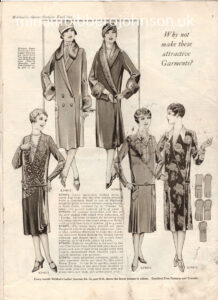
By 1927 most women were wearing their skirts at knee length or just below it when Weldon’s Needlework Magazine offered patterns to readers who were ‘outsize.’
Outsize was a term used to define women who didn’t fit the prevailing and rather slender expectations of bust, waist and hip measurements when they were buying paper sewing patterns or a dress.
In 1927 a size 14 corresponded to a bust measurement of 32 inches, hips of 35 and the waist was ignored completely. With emphasis on the hips and a boxy silhouette waists measurements were the same as the bust or hip and didn’t need definition, but not every woman fitted them nonetheless.
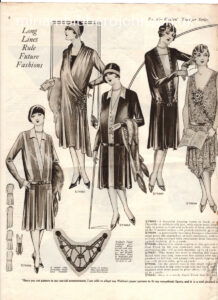
You could be forgiven for thinking these outfits look exactly the same as any other style that was advertised in the mid to late Twenties, which is correct. However look closely and you see the fabric dimensions accommodate bigger sizing – some using up to 4 1/2 yards of fabric in comparison to 1 or 2 – and with that the pattern pieces expanded also, a process called ‘grading’ that we use today.
Women with a bigger bust are particularly marked out in the second page. Without sturdy bras to uplift, crossover seams were designed to fall across the torso and a concealing panel of fabric was inserted across the upper bodice also incorporated into the dress.
Shoulders and hips often needed to be wider than 35 inches, arms wider also and on page 1, the line drawings of the front and back pieces indicate their shapes. Line drawings of the dimensions of clothes like these are called Fashion Flats and are still in use today.
Paper patterns – how many women made clothing – would have been made to fit more youthful dimensions and so these offered a way of being fashionable with ready-made pattern pieces cut to shape.
The woman had to create them, choose the fabric and decide on the embroidery also; if she had a dressmaker she could ask them to be made.
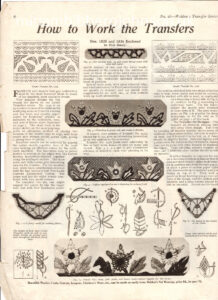
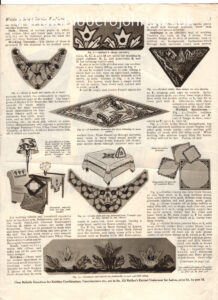
Embroidery was key to finishing design X79889 and X79887, which also had gauging or cartridge pleating on the left hip gathering up fabric into a tightly ruched set of pleats.
To make the panel of embroidery above them, woman would prick tiny holes through the transfers onto the fabric then dust them with tailor’s or embroidery chalk before removing the transfer and following the marks they left.
Embroidery threads were made of silks and could be chosen in a myriad of colours, it was the woman’s choice what tones they emphasised and usually picked out a part of the dress like patterned jewellery, to add detail and interest.
An alternative method would have been to sew through the fine paper provided with the magazine. Once the transfer was completed, it would have been taken out from under the stitching by pulling on the paper to remove it, a method many sewing machine embroiderers use today.
Although published for the mass-market, Weldons indicates the level of sewing and embroidery skills expected of their readers. Items like these were the opposite of fast-fashion, the quick manufacturing processes of brands today.
Made of fabrics like silk charmeline and velvet, the investment in terms of cost as well as time was extensive and would have stayed in a woman’s wardrobe for far longer than a season or year.
Want to know more about Mira’s other career? Watch the House of Mirelle for free on YouTube
© Carrie Henderson. 2021. All Rights Reserved.