
It’s a long tale, how the Bridge was built. And the story isn’t only about politics and engineering, it’s also about people’s memories, including my own. Scoot over and read more on my Instagram page.
THERE IS NO HUMBER BRIDGE
On 31st January 1953, the Hull Daily Mail ran this striking headline sounding less like a news report than a challenge. Anyone reading would have taken a sharp intake of breath.
In his speech, Commander Maitland, Lincolnshire MP from the area of Horncastle, dashed the hopes of thousands that Parliament was acting on a long held plea.
Hull desperately needed a bridge between it and Lincolnshire
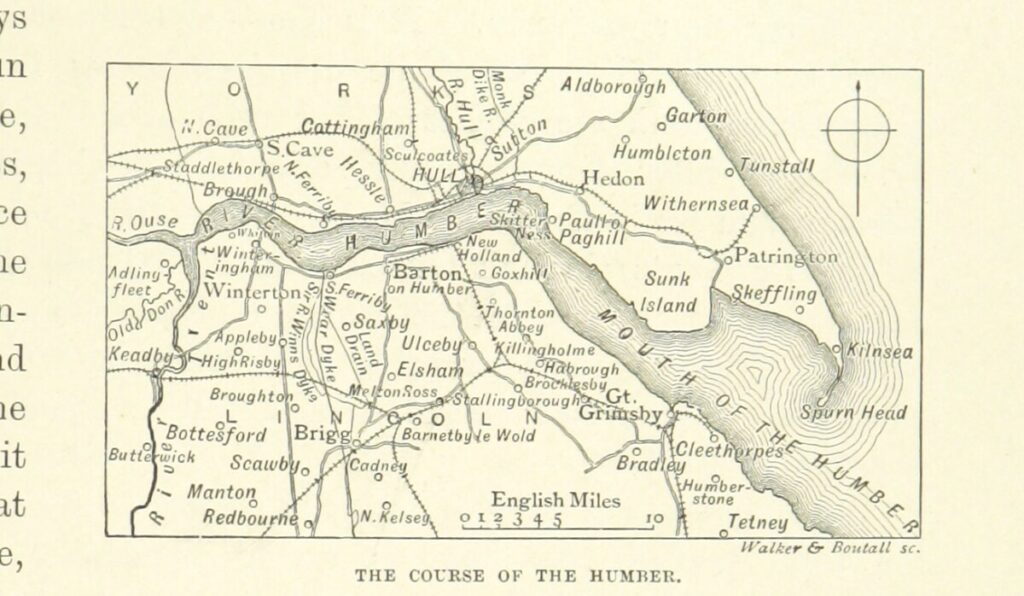
For Hull, the Humber was both a gateway and a barrier. There was no road between the north bank and south, where Grimsby – another massive sea port – lay.
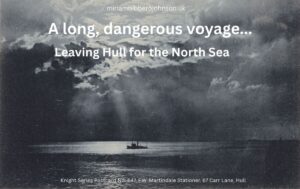
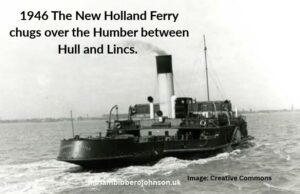
Car drivers could drive onto the Farringford Ferry then sail between Victoria Pier and New Barton and drive off the other side. Or go round the Humber – a long detour inland, the journey the rail network still takes.
He had to ‘go round’ to get to Hull, said my father when we lived in Lincolnshire – still true in the late Sixties and Seventies as it had been every year up until that point.
Personal memories
Hull resident Anne said she ‘can remember Mum and Dad talking for years about when the Humber was going to get a bridge.’
It was such a long-held dream of everyone in the area. Hanging on to news reports and announcements wishing upon wish that it would get an OK.
A bridge was the solution. Economic survival depended on it. Hull needed its swift, ease of road travel particularly as cars, lorries and vans became so important to imports and exports to and from the Docks.
Westminster ignored the plea
Striking a chill into the hearts of those reading, everyone in Hull and Lincs knew the Bridge took top-down, political will. It had been the same since the Twenties.
Humber Bridge and the 1920s
The idea of bridging the Humber Estuary was decades old. In 1928, proposals developed by engineers Freeman, Fox & Partners fell to nothing against the backdrop of the Depression and World War I.
There was no money left to invest, said Parliament. But Hull refused to be beaten. It found other ways to bring it to life.
Famous for the Sydney Harbour Bridge in Australia, Sir Ralph Freeman stepped in and created a new design. After Maitland’s statement to the House, all was not lost, thank goodness.
1955 brings new hope
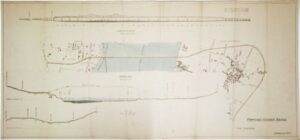
Freeman Fox & Partners estimated the cost of their bridge would be approximately £15 million, about £510m today. But, their design was beautiful, and everyone loved it.
Impressive and permanent. Pinned in place with struts and cables. The suspension bridge would span 4,500 feet from Hessle to Barton-on-Humber on the other side.
Can’t Parliament see its importance?
Parliament baulked. Pouring money into the Bridge took funding away from other parts of Britain. Even with the sketched out design, it completely stalled.
And the Humber itself made it difficult; Freeman’s bridge would have interrupted a huge, busy riverway. It was also difficult to build on shifting sand.
How frustrating. How impossible it seemed. As the years rolled by, the Farringford Ferry still chugged across the Humber from Victoria Pier to New Barton. People still took the long train journey ‘all the way round’ in a car or took the train.
But like Churchill, the Hull Daily Mail didn’t give up and neither did the Hull Corporation.
Humber Bridge Act 1959
Third time lucky. In 1959 a new Act was passed after the failed Humber Bridge Bills in 1931 and 1933.
Everyone cheered. The Humber Bridge Act provided the legal framework to built what would become today’s Humber Bridge.
A new design
It needed a new design. Using the idea of struts and cables first proposed by Freeman, Bernard Wex took forward a new design. Moving the site further down the Riverbank away from docks and shipping.
This time it would work, wouldn’t it?
Anne’s parents were right. The Bridge was taking forever but the plan didn’t die. Even after the Act of 1959, and the new plans, there were still more delays. But finally in a new political landscape, it happened. In 1971, it was agreed.
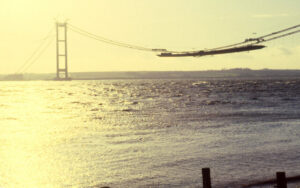
The bridge’s two main towers would stand on opposite sides of the estuary, carrying enormous suspension cables from which the road deck would hang.
In July 1972, the first spades hit the ground in Hessle on the Humber foreshore.
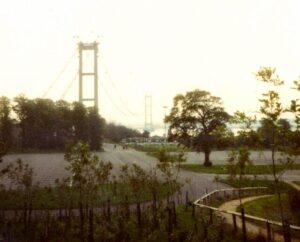
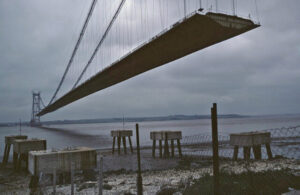
Photos show how miraculous a structure it was while it was being built. Rising up to the sky along the Hessle foreshore. The same place people saw Marcus Bibbero do his Humber bet in August 1888.

The Bridge completely changed the landscape. Aren’t these photos of its construction stunning.
Queen Elizabeth opens the Humber Bridge – July 1981
Sixty years after the first plans to span the Humber, cars zoomed over it on 24th June 1981. Queen Elizabeth coming to Hull and opening it to cheering crowds on 17th July.
Hull never looked back. On 24th July, the Farringford ferry made its last ever journey. One last time, it chugged between Victoria Pier and the other side.
It was worth the wait. And the campaign. Hull never looked back.
My personal story.
‘Let’s meet in the English Muse,’ said Sue Warriner, ‘on Newland Avenue.’ I agreed. Sue was one of the first people who spoke to me about the House of Mirelle, telling me what she remembered when it opened.
‘I’ll take you to my favourite spot,’ she decided.
‘Ok.’
I hopped in the car, small and red, listening to her telling me she was taking me to see the Bridge. There in ten minutes from the Avenues, Sue talking all the way. We parked on a slip road under the struts on the North side.
“When it opened, we walked all the way over,” she said, “then back again.” She stared upwards from the front seat of her car while I craned my neck higher. She looked up and across. My eyes followed for what seemed like minutes.
I was astonished, looking across to Lincs. Its scale, reaching for miles. Listening to Sue, I got out and walked down towards the Humber. Taking this photo of its simple, concrete spans above a grey, rocky shoreline. Thinking about Marcus Bibbero and his famous swim.
‘How on earth did he do it?’ I whispered to myself. ‘It looks calm enough, but the waters are deep.’
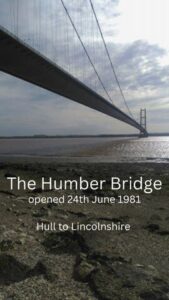
It’s stunning, I thought. Very elegant and impressive. I wonder how it feels to go across? Little did I expect that we’d be doing just that.
What an amazing journey, I thought. But the surprises weren’t done that day. Read about what happened next on my Instagram page @carriehenwriter.
What do you remember of the opening of the Humber Bridge?
Tell me more on Instagram or our Facebook page.
Carrie Henderson. October, 2026.