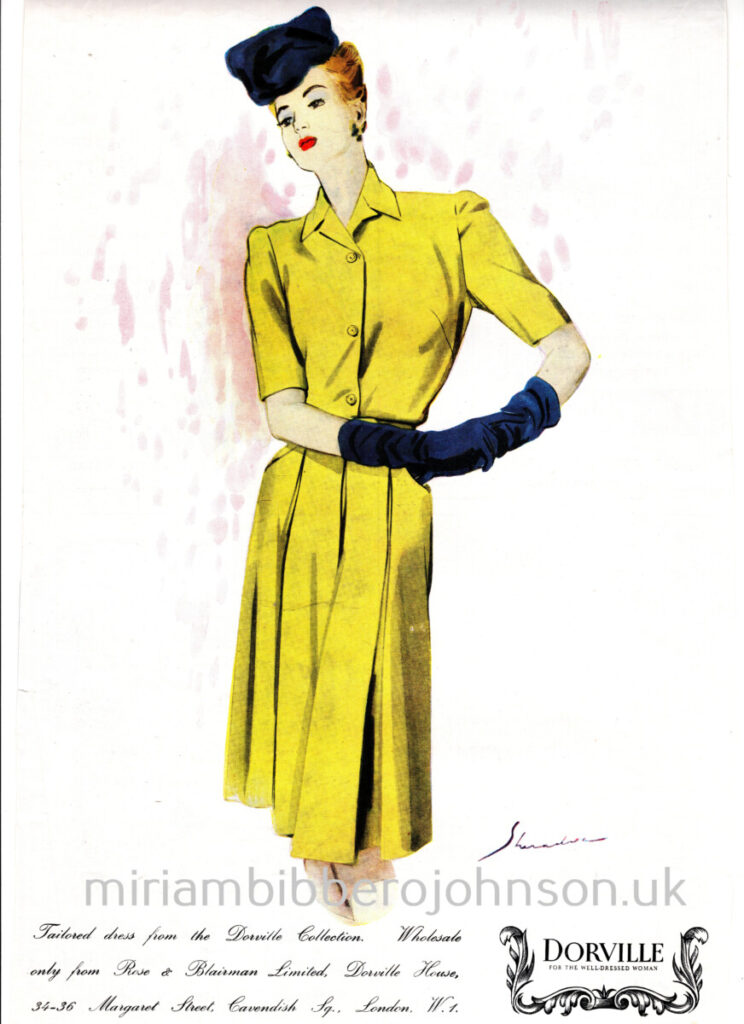
‘Tailored dress from the Dorville Collection. Wholesale only from Rose & Blairman Limited, Dorville House, 34-26 Margaret Street, Cavendish Square, London, W1.’
Published in 1950, this canary yellow dress indicates the direction of travel at the beginning of the decade. It was designed for Spring, Summer ’50 in the season before, around Autumn Winter 1949.
Dorville was a British clothing brand established long before 1950 that in common to all fashion houses, survived by making Utility clothing during the war until early 1952 when the scheme ended. Utility was a national textile and clothing scheme controlled by the Government and filled shop shelves almost entirely throughout the War years and beyond.
Clothes rationing had been abolished in March the year previously, but Utility persisted along with a trend for functionality of design. This dress is for wearing during the day and it’s noticeable that the New Look was not translated into its silhouette, a curiosity when others adhered to Parisian fashions rigorously.
By 1949 Utility had been the mainstay but was beginning to wear thin in the public imagination. Tax-free, those who could afford luxury items didn’t need to save money and there was growing public dissatisfaction with anything that held back their freedom, particularly reducing competition in the business of clothing design.
Reminding people of the worst of the hardship, by 1950 many companies left the word out of advertising as a means of persuading more to purchase Utility designs. It doesn’t say so and although eye catching in its use of strong colour, this dress has some of the trademark details suggestive of it being a Utility design.
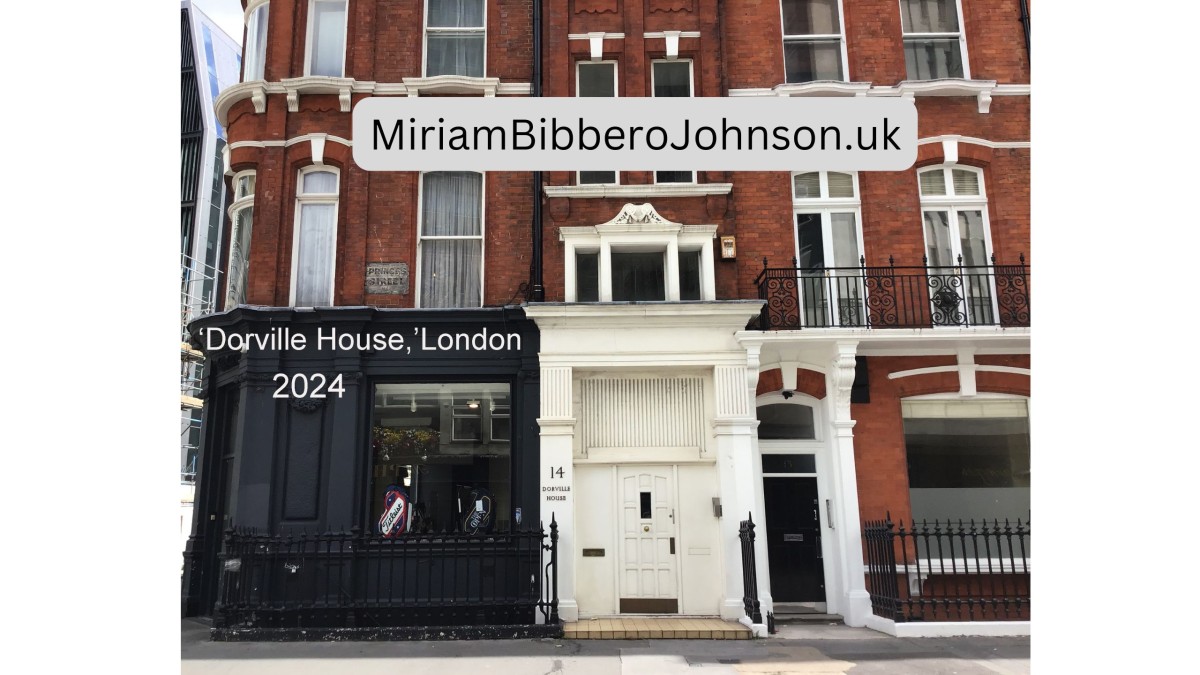
When they sat down at their desks to imagine the new collection, Dorville thought about what they could manufacture, what would be cost-effective as well as what shops like The House of Mirelle would buy.
It was designed with a simple shirt-style bodice, sleeves without a cuff, a small collar and no embellishments and there were two box pleats making in a fold along the skirt and closed with 3 or 4 buttons down the front of the bodice.
We cannot see a belt because it’s covered by the gloves but is probably hidden behind them. Its two pockets at the side seams were a nod to a more relaxed attitude at the end of the decade after rules said ‘you can’t waste fabric,’ ended with the ration.
There were very few additional details that would have made it time consuming to manufacture or be wasteful of fabric, components of Utility design.
The following description published in June 1945, five years earlier could easily describe this dress.
“Summer weight, woollen. Contrast blouse front. Convertible neckline. Buttoned waist. Tie belt. Short sleeves. Gay colours: Sky/Cherry, Emerald/Brown **, Royal/Black, Navy/Red, Sky/Brown etc. American sizes 12 to 16. ”
At Anstey’s department store that once existed in Hull’s Kingston Square, this dress would have cost 55 shillings or eleven coupons.
American sizing was very much the way forward at the end of the War years and increasingly characterised manufacture and design. At the outbreak of War very few American clothes were featured in the British marketplace but once Paris fell in 1940 and they joined Axis forces, they became intermingled with British design.
When the Government imposed standard sizing on British clothes manufacturers – part of the Utility scheme – it was the beginning of the end of idiosyncratic sizing that had happened up until then. Not only did it tell the public exactly what size they could expect but it extended their marketplace; from then Brits sold in America in very large quantities and it revolutionised design.
This dress is an example of the changing face of the post-war decade. In two years Utility clothing would be abolished but the shirtwaister dress became part of almost every woman’s wardrobe in the Fifties, wide skirts stiffened by petticoats dipped in sugar solution to make them stiffer or made from a firm fabric called Buckram.
The classic pleated skirt with a shirt-style bodice lasted into the Seventies and Eighties and has returned to fashion again. This bright yellow dress is their originator, their grandmother in style and design.
Would you wear this dress today? Let us know on our Facebook page.
Want to know more about Mira’s other career? Watch the House of Mirelle for free on YouTube
** readers note. The original word used in the advert for this shade of fabric is a racial slur and has been edited and removed for this article.